
> “The owners who get the best outcomes treat their exit as a multi-year project, not a transaction.” – Keith Wegen, Flatirons Capital Advisors
Whether you’re planning to sell your business in 2027 or several years down the road, your exit timeline should shape your priorities today.
We asked nine M&A advisors what business owners should focus on in the year ahead, from preparing for a near-term sale to making longer-term improvements that could increase business value. Their insights, along with real-world transaction examples, highlight how preparation can influence the sale process and its outcome.
TL;DR
- Selling in 2027? The clock is ticking. Aim to hire an M&A advisor within the next two months and go to market in Q1 2027. In the meantime, get your financials in order, reduce owner dependence, and protect earnings.
- Selling in 2028 or beyond? Set a target exit month and plan to begin evaluating advisors 12-15 months beforehand. Use the time leading up to that to build value by improving margins, diversifying revenue, strengthening management, and working with a wealth manager to clarify your financial goals.
- Why preparation matters: Real transactions show the stakes, from reduced buyer offers and delayed sales to competitive bidding and fewer surprises during diligence.
Thank you to the nine M&A advisors who contributed their expertise and real-world experiences to this article.

Planning to Sell in 2027? Here’s What to Prioritize Now
For business owners targeting a sale by the end of 2027, the window to prepare is narrowing. While a year-end closing is still realistic, M&A advisors emphasize the importance of getting organized now, strengthening financial and operational readiness, and maintaining business performance throughout the sale process.
Work Backward From Your Target Closing Date
A business sale can take anywhere from six months to a year or longer, depending on the company’s readiness and the complexity of the transaction. For owners hoping to close by December 2027, several contributing advisors recommend targeting the first quarter of the year to go to market.
> “Work backward. A sale process typically runs 6–9 months, plus 2–3 months of prep, so a year-end 2027 close means engaging an advisor in Q1 2027 at the latest, but engaging an advisor in late Q4 2026 can allow you to get to market quickly in Q1.” – Scott Mitchell, SDR Ventures
> “The short answer: yes, there is still time, but only if the owner starts getting organized now. We used to tell clients a deal took six months or so to close. Today, nine to twelve months from engaging a banker to a funded close is the more realistic expectation.” – Rick Thomas, FOCUS Investment Banking
Get Your Financials Ready for Buyer Scrutiny
Clean, reliable financial records are essential to a successful sale process. Advisors recommend preparing accrual-based financial statements, documenting EBITDA adjustments and add-backs, and considering a sell-side Quality of Earnings (QoE) report to identify potential issues before buyers begin their own due diligence.
> “If your financials are a mess, your process will be a mess, and your odds of closing decline.” – Max Friar, Calder Capital
> “Finding a problem now gives you time to address it. Finding it during buyer diligence can put the price and the transaction at risk.” – Jay Jung, Embrac Advisors
Reduce Owner Dependence and Strengthen Your Management Team
Buyers want confidence that a business can continue operating successfully after its owner exits. For owners planning to sell in 2027, strengthening the management team, delegating key responsibilities, and reducing reliance on the owner for day-to-day decisions can show the business is positioned for a smooth transition.
> “A close by the end of 2027 is realistic if 1) financials are buyer-ready now; 2) the business can run for 90 days without the owner; and 3) the owner is emotionally ready to sell.” – Keith Wegen, Flatirons Capital Advisors
> “You do not need to become an absentee owner. But if every customer relationship, pricing decision, and operational issue runs through you, a buyer will have concerns about what happens when you leave.” – Jay Jung, Embrac Advisors
Protect Business Performance and Avoid Last-Minute Disruptions
Maintaining consistent financial and operational performance is particularly important in the months leading up to a sale. Buyers closely evaluate recent earnings trends, so owners should stay focused on running the business and avoid major changes that could temporarily disrupt operations.
> “Buyers watch trailing results during diligence, and a soft quarter invites a re-trade.” – Scott Mitchell, SDR Ventures
> “What this time should not be used for is making large structural changes that could cause disruption, which can take many months to implement and could initially disrupt operations.” – Cody Clemens, ASA Ventures Group
Planning to Sell in 2028 or Beyond? Use the Time to Build Value
For owners with a longer timeline, the first step is identifying which aspects of the business could most influence buyer demand and valuation, then setting priorities for improvement.
Focus on Increasing Business Value, Not Just Preparing for a Sale
Unlike owners targeting a near-term exit, those with a longer timeline have the flexibility to make meaningful improvements to the business itself. Rather than focusing primarily on transaction readiness, the priority shifts to identifying the factors that influence buyer demand and valuation, then building a plan to improve them over time.
> “With that horizon, you can change what buyers pay for instead of just packaging what exists.” – Scott Mitchell, SDR Ventures
> “The owners who get the best outcomes treat their exit as a multi-year project, not a transaction.” – Keith Wegen, Flatirons Capital Advisors
Owners can incorporate these priorities into their annual business plans, setting measurable goals and reviewing progress over time.
Improve Profitability, Revenue Quality, and Customer Diversification
Owners with a longer exit timeline can focus on improving profit margins, building recurring revenue, and reducing customer concentration. These improvements can make a business more attractive to buyers, particularly when owners have time to demonstrate sustained results.
> “A buyer will place more weight on a demonstrated history of stronger margins or recurring revenue than on a plan to achieve those things after closing.” – Josh Gladtke, Good Hope Advisors
> “Grow EBITDA, not just revenue. Focus on margin, recurring revenue (maintenance agreements, service contracts) and pricing discipline. Every dollar of EBITDA is worth a multiple of itself at exit.” – Keith Wegen, Flatirons Capital Advisors
Make Structural Improvements and Give Them Time to Show Results
A longer exit timeline gives owners time to implement meaningful operational changes, such as strengthening management or improving internal processes, and demonstrate their effectiveness before going to market.
> “If an owner is targeting a 2028 exit or beyond, this is a great chance to make any large structural changes that can materially increase a company’s value, but typically require an extended implementation period.” – Cody Clemens, ASA Ventures Group
> “You also have time to demonstrate that those changes work. Hiring a strong operations leader three months before a sale is helpful. Showing that the person has successfully run operations for two years gives a buyer much more confidence.” – Jay Jung, Embrac Advisors
Know Your Numbers and Set Exit Planning Goals
A longer timeline also gives owners an opportunity to set clear exit goals and measure progress. This includes understanding what their business may be worth, how much they could take home after a sale, and whether those proceeds would support their financial goals.
> “The biggest risk with a longer horizon is complacency. Owners who feel they have time tend to defer the hard changes, and then a health issue, a lost customer, or a market shift forces a sale on a timetable they did not choose.” – Emery Ellinger, Aberdeen Advisors
> “Owners naturally focus on the sale price, but what matters to them is how much they keep.” – Jay Jung,
Scott Bushkie, Founder of Cornerstone Business Services, recommends evaluating three numbers when planning an exit. Comparing these three numbers can help owners identify a potential gap between expected sale proceeds and their financial goals, then plan accordingly.

Real-World Examples: How Exit Preparation Impacts Sale Outcomes
M&A advisors shared real-world examples of how preparation, or a lack thereof, affected business sale processes and outcomes.
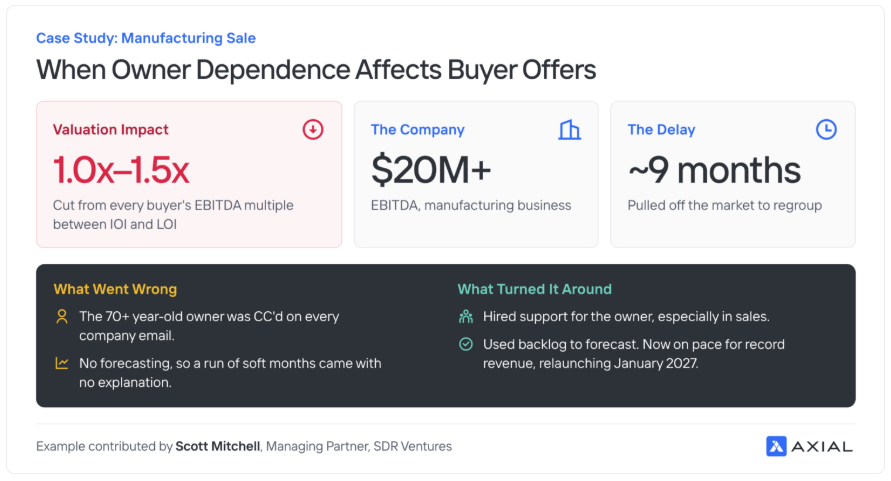
The Cost of Owner Dependence
Scott Mitchell, Managing Partner at SDR Ventures, shared an example of a manufacturing business whose sale process was complicated by heavy owner involvement and limited financial forecasting. These challenges became apparent to buyers and forced the company to reconsider its approach.
The Value of an Independent Management Team
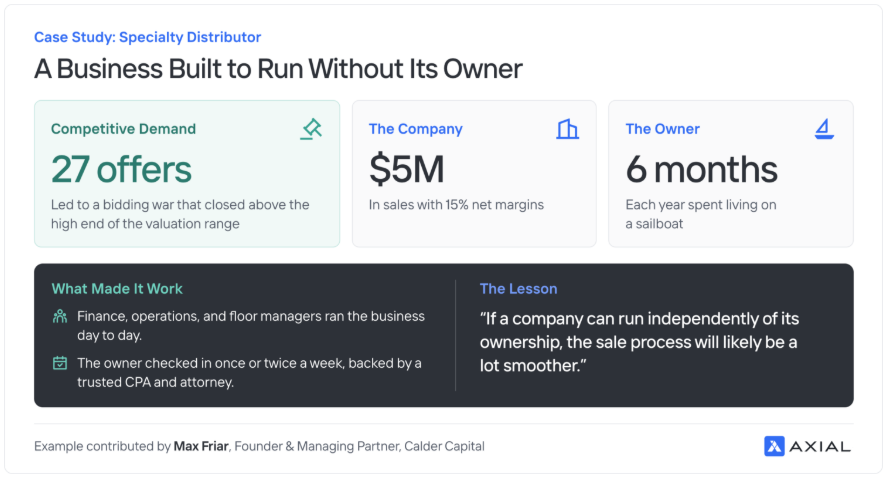
Max Friar, Founder of Calder Capital, shared the example of a specialty distributor whose management team handled daily operations while the owner spent much of the year living on a sailboat.
Preparation That Protected the Deal
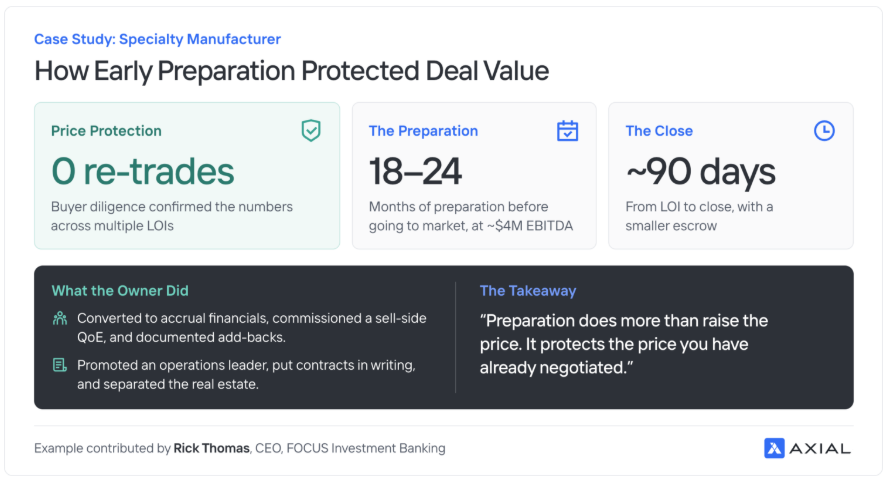
Rick Thomas, CEO of FOCUS, shared how a specialty manufacturer addressed financial, operational, and legal issues well before going to market, helping the company navigate buyer diligence with fewer surprises.
Addressing Customer Profitability Before a Sale
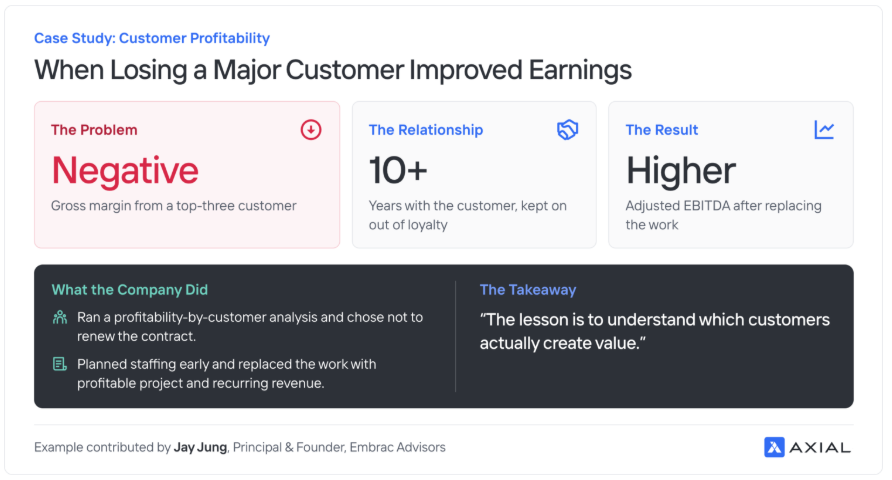
Jay Jung, Founder of Embrac Advisors, shared how a business discovered that one of its largest and longest-standing customers was actually unprofitable. Rather than maintain the relationship, management made a deliberate decision to address the issue ahead of a sale.
Frequently Asked Questions About Selling a Business
How long does it take to sell a business?
A business sale can take six to twelve months or longer, depending on the company’s readiness, buyer diligence, and transaction complexity. Owners should also account for preparation before going to market. Axial’s Knowing When to Sell offers additional guidance on evaluating the right time to sell.
When should I start preparing to sell my business?
The right timeline depends on the business and the owner’s goals. Starting early can provide more flexibility to address potential issues and evaluate exit options. Axial’s 1,000 Day Exit Plan provides a framework for longer-term preparation.
What should I do before putting my business up for sale?
Common areas to evaluate include financial reporting, management structure, customer concentration, and operational readiness. The priorities will vary based on the business and its anticipated sale timeline. For additional considerations, see Preparing a Business for Sale in 3 Steps.
How can I increase the value of my business before selling?
Depending on the business, opportunities may include improving profitability, strengthening management, building recurring revenue, or reducing customer concentration. The potential impact of these changes will depend on buyer priorities and market conditions. Axial’s How to Maximize Business Value Before You Sell offers additional perspectives.
About Flatirons Capital Advisors
Flatirons Capital Advisors, LLC (www.flatironscap.com) is a Mergers and Acquisitions advisory firm that helps privately held companies sell their businesses and acquire other businesses. Our unique business model affords sell-side advisory clients the ability to improve their company's performance, earnings, and effectiveness in the short-term, while simultaneously increasing their market value for a future sale. Flatirons has offices in Colorado, Florida, Illinois, and Texas.
About Flatirons Capital Advisors
Flatirons Capital Advisors, LLC is an investment banking firm that helps privately held companies sell their businesses, acquire other businesses, and raise capital. Our unique business model affords sell-side advisory clients the ability to improve their company's performance while simultaneously increasing their market value for a future sale.